Stella Yin
Nanyang Technological University, Singapore
xin013 [AT] e.ntu.edu.sg
Bio
I am a Postdoc researcher at 🇸🇬 Nanyang Technological University (NTU), Singapore. My research sets at the intersection of information science, artificial intelligence, and education, with a passion for understanding how data-driven technologies can support personalized learning experiences.
I received my Ph.D. in Information Studies from Nanyang Technological University, where I was advised by Professors Dion Hoe-Lian Goh and Choon Lang Quek. Prior to that, I earned a Bachelor's degree from Sun Yat-sen University, China, and a Master's degree from the University of Manchester, UK.
I am building the Special Interest Group on Human-AI Collaborative Learning, Exploration, and Discovery (InspAIre). If you share similar interests, I'd love to connect, exchange ideas, and explore potential collaborations.
Recent News
Jun 2026: I will visit 🇰🇷 Seoul in July to present MMLA paper at AIED S2026. November 2025: 🇺🇸WonderKids research proposal received the Elfreda A. Chatman Research Award by the Association for Information Science and Technology (ASIST) Special Interest Group on Information Needs, Seeking, and Use (SIG USE). August 2025: SingaKids AI Tutor demonstration featured at the SG60 Heart & Soul Experience, presented by the Ministry of Digital Development and Information (MDDI) and National Library Board Singapore (NLB), running from 26 Aug to 31 Dec 2025. April 2025: Presented paper titled "Code Buddies: How Pair Programming Enhances Computational Thinking, Self-Efficacy, and Engagement in Elementary School Students" at the American Educational Research Association (AERA) Annual Meeting, Denver, Colorado. March 2025: Presented paper titled "Scaling Up Collaborative Dialogue Analysis: An AI-Driven Approach to Understanding Dialogue Patterns in Computational Thinking Education" at the 15th International Conference on Learning Analytics and Knowledge (LAK'25), Dublin, Ireland.Publications
Please find all publications on my Google Scholar.
* denotes equal contributions.
Leveraging LLMs for Dynamic Engagement Pattern Recognition in Collaborative Learning PDF
Stella Xin Yin, Zhengyuan Liu, Dion Hoe-Lian Goh, Nancy F. Chen
AIED 2026
We introduce a MMLA framework that leverages LLMs to dynamically and hierarchically recognize engagement patterns. Our approach moves beyond static scoring by integrating verbal dialogue and non-verbal behavioral cues, and identifies and represents evolving engagement trajectories in an interpretable, descriptive form. We demonstrate its effectiveness on a dataset of 1,072 video recordings from 13 student groups in a computational thinking course.
Decoding the Success of Collaboration in Computational Thinking PDF
Stella Xin Yin, Dion Hoe-Lian Goh, Choon Lang Quek
Learning and Instruction 2025
Through a between-subject experiment with 79 fifth-grade elementary school students, this study examines how self-efficacy, engagement, and collaboration preference influence CT skills and learning satisfaction. It also compares the relationships among these motivational factors between pair programming and individual learning contexts.
Scaling up Collaborative Dialogue Analysis: An AI-driven Approach to Understanding Dialogue Patterns in Computational Thinking Education PDF
Stella Xin Yin, Zhengyuan Liu, Dion Hoe-Lian Goh, Choon Lang Quek, Nancy F. Chen
LAK 2025
We introduce an AI-driven collaborative dialogue analysis framework that effectively analyze classroom recordings with high accuracy and efficiency. After identifying the dialogue patterns, we investigate the relationships between these patterns and CT performance. Four clusters of dialogue patterns have been identified: Inquiry, Constructive Collaboration, Disengagement, and Disputation.
Understanding Determinants of Student Behavioral Intention in Singapore's AI Education: Insights from the Situated Expectancy-Value Theory PDF
Stella Xin Yin, Dion Hoe-Lian Goh
Interactive Learning Environments 2025
Guided by situated expectancy-value theory (SEVT) and the theory of planned behavior (TPB), this study investigated the role of supportive environment and expectancy-value-cost beliefs in shaping university students’ behavioral intention in AI education. A total of 609 university students participated in this study. The findings highlighted the significant role of expectancy-value beliefs in motivating students’ intention to learn and use AI.
SingaKids: A Multilingual Multimodal Dialogic Tutor for Language Learning PDF
Zhengyuan Liu, Geyu Lin, Hui Li Tan, Huayun Zhang, Yanfeng Lu, Xiaoxue Gao, Stella Xin Yin, Sun He, Hock Huan Goh, Lung Hsiang Wong, Nancy F. Chen
ACL 2025
We introduce SingaKids, a dialogic tutor designed to facilitate language learning through picture description tasks. Our system integrates dense image captioning, multilingual dialogic interaction, speech understanding, and engaging speech generation to create an immersive learning environment in four languages: English, Mandarin, Malay, and Tamil.
Collaborative Learning in K-12 Computational Thinking Education: A Systematic Review PDF
Stella Xin Yin, Dion Hoe-Lian Goh, Choon Lang Quek
Journal of Educational Computing Research 2024
This study examined 43 empirical studies that have applied CL strategies, ranging from 2006 to 2022. First, a wide range of theories and frameworks were applied to inform research questions, pedagogical design, and research methodologies. Second, despite the acknowledged importance of group composition in effective CL, a large number of studies did not provide details on how the students were grouped. Third, six types of CL activities and instructional designs have been identified in CT classrooms.
Personality-Aware Student Simulation for Conversational Intelligent Tutoring Systems PDF
Zhengyuan Liu*, Stella Xin Yin*, Geyu Lin, Nancy F. Chen
EMNLP 2024
We propose a framework to construct profiles of different student groups by refining and integrating both cognitive and noncognitive aspects, and leverage LLMs for personality-aware student simulation in a language learning scenario. We further enhance the framework with multi-aspect validation, and conduct extensive analysis from both teacher and student perspectives. Our experimental results show that state-of-the-art LLMs can produce diverse student responses according to the given language ability and personality traits, and trigger teacher's adaptive scaffolding strategies.
Scaffolding Language Learning via Multi-Modal Tutoring Systems with Pedagogical Instructions PDF
Zhengyuan Liu*, Stella Xin Yin*, Carolyn Lee, Nancy F. Chen
2024 IEEE Conference on Artificial Intelligence (CAI)
We investigate how pedagogical instructions facilitate the scaffolding in ITSs, by conducting a case study on guiding children to describe images for language learning. We construct different types of scaffolding tutoring systems grounded in four fundamental learning theories: knowledge construction, inquiry-based learning, dialogic teaching, and zone of proximal development.
Optimizing Code-Switching in Conversational Tutoring Systems: A Pedagogical Framework and Evaluation PDF
Zhengyuan Liu*, Stella Xin Yin*, Nancy F. Chen
SIGDIAL 2024
We present a pedagogy-inspired framework that introduces traditional classroom practices of code-switching to intelligent tutoring systems. Specifically, we develop fine-grained instructional strategies tailored to multilingual and educational needs. We conduct experiments involving both LLM-based evaluation and expert analysis to assess the effectiveness of translanguaging in tutoring dialogues.
Leveraging LLMs for Dynamic Engagement Pattern Recognition in Collaborative Learning PDF
Stella Xin Yin, Zhengyuan Liu, Dion Hoe-Lian Goh, Nancy F. Chen
AIED 2026
We introduce a MMLA framework that leverages LLMs to dynamically and hierarchically recognize engagement patterns. Our approach moves beyond static scoring by integrating verbal dialogue and non-verbal behavioral cues, and identifies and represents evolving engagement trajectories in an interpretable, descriptive form. We demonstrate its effectiveness on a dataset of 1,072 video recordings from 13 student groups in a computational thinking course.
Decoding the Success of Collaboration in Computational Thinking PDF
Stella Xin Yin, Dion Hoe-Lian Goh, Choon Lang Quek
Learning and Instruction 2025
Through a between-subject experiment with 79 fifth-grade elementary school students, this study examines how self-efficacy, engagement, and collaboration preference influence CT skills and learning satisfaction. It also compares the relationships among these motivational factors between pair programming and individual learning contexts.
Scaling up Collaborative Dialogue Analysis: An AI-driven Approach to Understanding Dialogue Patterns in Computational Thinking Education PDF
Stella Xin Yin, Zhengyuan Liu, Dion Hoe-Lian Goh, Choon Lang Quek, Nancy F. Chen
LAK 2025
We introduce an AI-driven collaborative dialogue analysis framework that effectively analyze classroom recordings with high accuracy and efficiency. After identifying the dialogue patterns, we investigate the relationships between these patterns and CT performance. Four clusters of dialogue patterns have been identified: Inquiry, Constructive Collaboration, Disengagement, and Disputation.
Mapping the Public Understanding of Computational Thinking Education: Insights from Social Q&A Platform Discussions PDF
Stella Xin Yin, Dion Hoe-Lian Goh, Choon Lang Quek, Zhengyuan Liu
Educational Technology & Society 2025
We collected questions and answers related to CT education on the Quora platform between 2010-2022. We then applied a topic modeling approach and identified 6 topics in questions and 14 topics in answers. Our findings revealed that people showed great interests but also uncertainty about CT education learning outcomes. Many people asked for suggestions on CT learning tools and platforms, but they struggled to identify appropriate information to support their learning needs. Among their answers, while people held positive attitudes toward CT education, they were concerned about the difficulties their children faced in the learning process and the problem of educational equity.
Understanding Determinants of Student Behavioral Intention in Singapore's AI Education: Insights from the Situated Expectancy-Value Theory PDF
Stella Xin Yin, Dion Hoe-Lian Goh
Interactive Learning Environments 2025
Guided by situated expectancy-value theory (SEVT) and the theory of planned behavior (TPB), this study investigated the role of supportive environment and expectancy-value-cost beliefs in shaping university students’ behavioral intention in AI education. A total of 609 university students participated in this study. The findings highlighted the significant role of expectancy-value beliefs in motivating students’ intention to learn and use AI.
COGENT: A Curriculum-oriented Framework for Generating Grade-appropriate Educational Content PDF
Zhengyuan Liu*, Stella Xin Yin*, Dion Hoe-Lian Goh, Nancy F. Chen
BEA 2025
We propose COGENT, a curriculum-oriented framework for generating grade-appropriate educational content. We incorporate three curriculum components (science concepts, core ideas, and learning objectives), control readability through length, vocabulary, and sentence complexity, and adopt a “wonder-based” approach to increase student engagement and interest.
SingaKids: A Multilingual Multimodal Dialogic Tutor for Language Learning PDF
Zhengyuan Liu, Geyu Lin, Hui Li Tan, Huayun Zhang, Yanfeng Lu, Xiaoxue Gao, Stella Xin Yin, Sun He, Hock Huan Goh, Lung Hsiang Wong, Nancy F. Chen
ACL 2025
We introduce SingaKids, a dialogic tutor designed to facilitate language learning through picture description tasks. Our system integrates dense image captioning, multilingual dialogic interaction, speech understanding, and engaging speech generation to create an immersive learning environment in four languages: English, Mandarin, Malay, and Tamil.
Collaborative Learning in K-12 Computational Thinking Education: A Systematic Review PDF
Stella Xin Yin, Dion Hoe-Lian Goh, Choon Lang Quek
Journal of Educational Computing Research 2024
This study examined 43 empirical studies that have applied CL strategies, ranging from 2006 to 2022. First, a wide range of theories and frameworks were applied to inform research questions, pedagogical design, and research methodologies. Second, despite the acknowledged importance of group composition in effective CL, a large number of studies did not provide details on how the students were grouped. Third, six types of CL activities and instructional designs have been identified in CT classrooms.
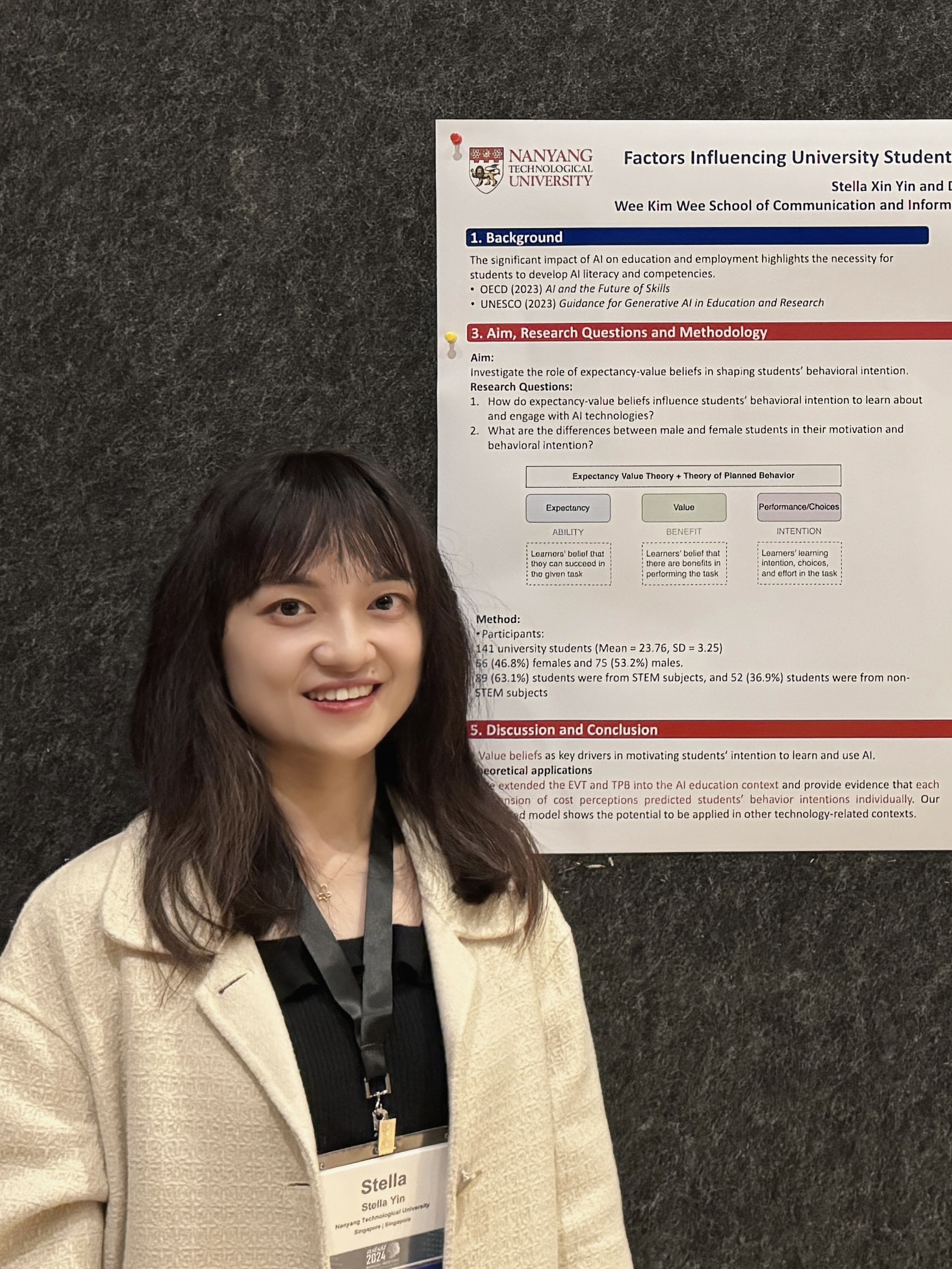
Factors Influencing University Students' AI Use and Knowledge Acquisition PDF
Stella Xin Yin, Dion Hoe-Lian Goh
ASIST 2024
We examined how university students' beliefs influenced their motivation to learn about and engage with AI technologies. Our findings demonstrated the significant role of expectancy-value beliefs in shaping students' behavioral intention. Additionally, we identified gender differences, which can inform educators in designing gender-specific interventions to enhance female students' motivation in AI learning.
Personality-Aware Student Simulation for Conversational Intelligent Tutoring Systems PDF
Zhengyuan Liu*, Stella Xin Yin*, Geyu Lin, Nancy F. Chen
EMNLP 2024
We propose a framework to construct profiles of different student groups by refining and integrating both cognitive and noncognitive aspects, and leverage LLMs for personality-aware student simulation in a language learning scenario. We further enhance the framework with multi-aspect validation, and conduct extensive analysis from both teacher and student perspectives. Our experimental results show that state-of-the-art LLMs can produce diverse student responses according to the given language ability and personality traits, and trigger teacher's adaptive scaffolding strategies.
Scaffolding Language Learning via Multi-Modal Tutoring Systems with Pedagogical Instructions PDF
Zhengyuan Liu*, Stella Xin Yin*, Carolyn Lee, Nancy F. Chen
2024 IEEE Conference on Artificial Intelligence (CAI)
We investigate how pedagogical instructions facilitate the scaffolding in ITSs, by conducting a case study on guiding children to describe images for language learning. We construct different types of scaffolding tutoring systems grounded in four fundamental learning theories: knowledge construction, inquiry-based learning, dialogic teaching, and zone of proximal development.
Optimizing Code-Switching in Conversational Tutoring Systems: A Pedagogical Framework and Evaluation PDF
Zhengyuan Liu*, Stella Xin Yin*, Nancy F. Chen
SIGDIAL 2024
We present a pedagogy-inspired framework that introduces traditional classroom practices of code-switching to intelligent tutoring systems. Specifically, we develop fine-grained instructional strategies tailored to multilingual and educational needs. We conduct experiments involving both LLM-based evaluation and expert analysis to assess the effectiveness of translanguaging in tutoring dialogues.
Honors and Awards
| 2025 | Elfreda A. Chatman Research Award, Association for Information Science and Technology, USA |
| 2025 | AERA International Student Award, American Educational Research Association, USA |
| 2025 | Oxford-Berkeley Summer Doctoral Program Scholarship, UC Berkeley, USA |
| 2022 | Simon Initiative's LearnLab Summer School Scholarship, Carnegie Mellon University, USA |
| 2022 | Ewha-Luce International Research Seminar Scholarship, Ewha Womans University, South Korea |
| 2022–26 | NTU Research Scholarship, Nanyang Technological University, Singapore |